Delegate to develop: the 5 stages of empowerment
Without delegation, you can't develop your team — or focus on what truly matters.
Delegation is not a nice-to-have. It is the prerequisite for team development and strategic leadership. If you're doing everything yourself, you're not leading — you're executing. And your team isn't growing.
The leaders who struggle most with delegation usually share one belief: "it's faster if I do it myself." And they're right — in the short term. But every time you skip delegation, you're choosing immediate output over long-term team capability. You're also choosing to stay stuck in execution instead of moving to strategy.
The good news: delegation is a skill, and like any skill, it gets better with a framework. The 5-stage model below gives you a clear language to be intentional about how you're working with each person on each task.
the 5 stages of delegation and empowerment
The stages are not a ladder you climb once and stay at the top. They're context-dependent. The same person can be in the "Leader" stage for a task they master and in the "Professor" stage for something new. Your job is to read the situation and adapt.
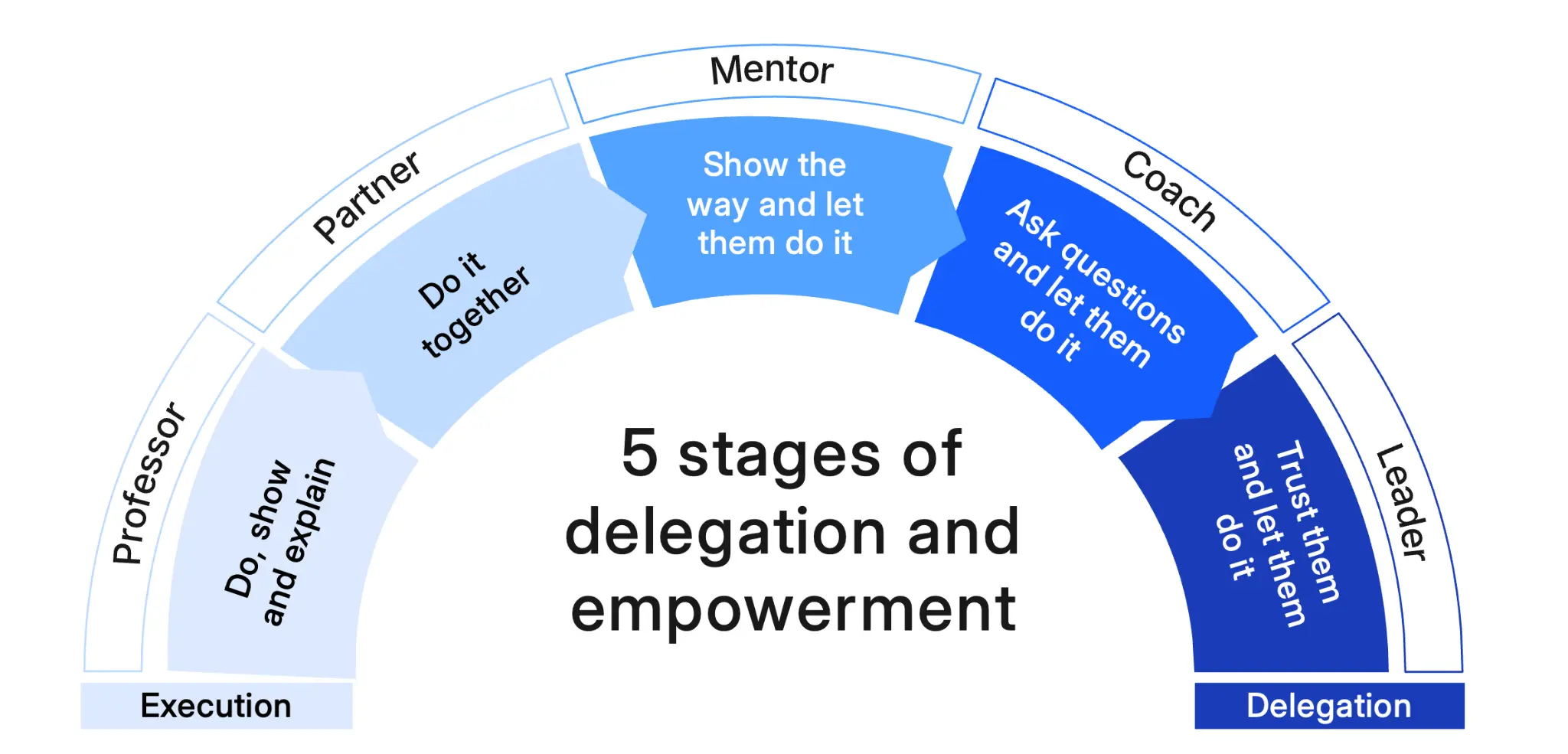
Stage 1: Professor — do, show and explain
You do the work while explaining what you're doing and why. Essential for new team members or complex tasks where the person has no prior experience. The focus is knowledge transfer.
Stage 2: Partner — do it together
You work side by side. They gain hands-on experience while you're present to guide in real time. Builds confidence and competence simultaneously.
Stage 3: Mentor — show the way and let them do it
You set the direction, they execute. You're available for questions but not involved in the day-to-day. They're developing independence.
Stage 4: Coach — ask questions and let them do it
You step back and ask questions rather than provide answers. The person does the work while you help them think through problems. This develops their decision-making and problem-solving skills.
Stage 5: Leader — trust them and let them do it
Full autonomy. They work independently, make decisions, and may start developing others. Your role is strategic oversight and removing obstacles. This is where true empowerment happens.
Track delegation in practice — for free
Elev.H helps you record observations, structure feedback, and develop each person on your team — based on 30 competencies and 150+ behaviors.
Want to go deeper on the Coach and Leader stages? The key skill is asking the right questions — not giving answers. A great starting point is The Coaching Habit by Michael Bungay Stanier, which gives you 7 essential questions that make coaching a daily habit, not a formal event.
how to choose the right stage
You won't become a Coach or Leader overnight — and you shouldn't try to be in those stages for everything. The right stage depends on two factors: the complexity of the task and the competence of the person.
High complexity or low competence
Stay closer to execution. Be a Professor or Partner. The risk of getting it wrong is high, and the person needs your presence to learn correctly.
Low risk or high competence
Move toward delegation. Be a Coach or Leader. Staying in execution mode here is micromanagement — it signals distrust and blocks growth.
The key is to be intentional. Before delegating a task, ask yourself: where is this person on this specific topic? And be explicit with them — showing this model to your team member can be powerful. When both of you understand the stages, you can have an honest conversation about where you are right now and what it would take to move forward.
That transparency builds trust. It turns delegation from something that "happens to" your team into a shared development journey.
the delegation checklist
Good delegation requires more than just assigning a task. Use this checklist every time you delegate — especially in the early stages. Over time, it becomes automatic and you won't need it anymore. But until then, it's your safety net against misalignment.
1. Context, purpose and ask
2. Expected output and format
3. Milestones and final deadline
4. Prioritization and urgency
5. Autonomy level
Ready to build a truly empowered team?
Elev.H helps you systematically develop your team using AI-powered feedback, structured frameworks, and continuous tracking. Free to start.
Create free account →References
- Blanchard, K., Oncken Jr., W. & Burrows, H. (1989). The One Minute Manager Meets the Monkey. William Morrow.
- Hersey, P. & Blanchard, K. H. (1969). Life cycle theory of leadership. Training and Development Journal, 23(5), 26–34.
- Bungay Stanier, M. (2016). The Coaching Habit: Say Less, Ask More & Change the Way You Lead Forever. Box of Crayons Press.
- Hackman, J. R. & Oldham, G. R. (1976). Motivation through the design of work. Organizational Behavior and Human Performance, 16(2), 250–279.