Every team goes through predictable stages of development. Understanding where your team is — and what it needs from you at each stage — is one of the most practical leadership skills you can develop.
Bruce Tuckman's model, first published in 1965, describes four stages: Forming, Storming, Norming, and Performing. The model is deceptively simple. The insight is not in memorizing the names — it's in recognizing the signs in real time and adjusting your leadership style accordingly.
One critical caveat: the model is not linear. Teams don't graduate from one stage to the next permanently. Adding a new member, changing goals, or a major organizational shift can push a performing team back to forming or storming overnight. The best leaders treat this as a dynamic, ongoing process — not a one-time journey.
The 4 stages of team formation
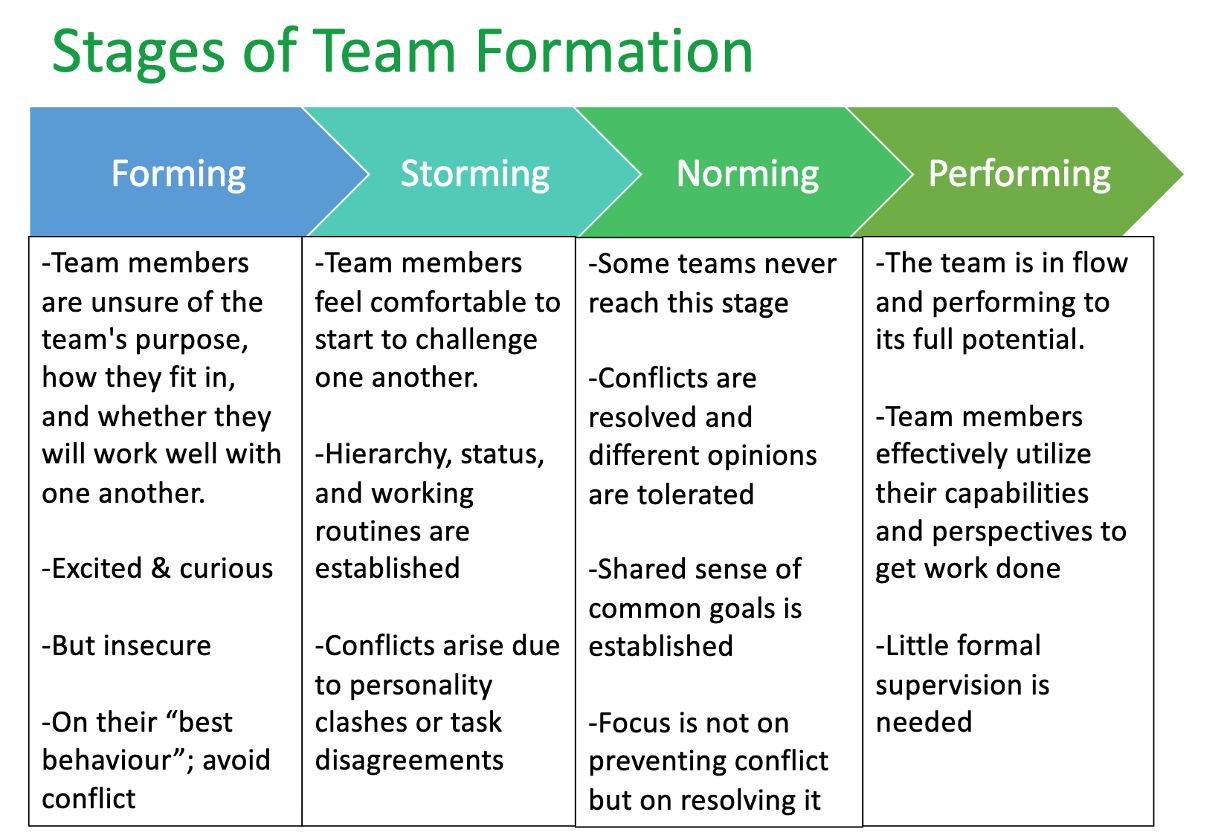
The team comes together for the first time. People are excited and curious, but also insecure. No one fully understands the team's purpose, how roles fit together, or how people will work with one another. Everyone is on their best behavior — conflict is avoided at all costs.
What you'll observe
- Team members are unsure of the team's purpose and how they fit in
- Excited and curious, but also insecure about their place
- On their 'best behavior' — avoiding conflict to make a good impression
- Dependency on the leader for direction and structure
- Little real work gets done; energy goes to relationship-building
Your role as a leader
Be directive. Provide clear goals, roles, and expectations. Create psychological safety early by modeling openness and welcoming questions. Don't confuse politeness for alignment — people are still figuring each other out.
Watch out for
Teams can get stuck here if the leader never creates conditions for honest dialogue. Permanent forming looks like a group that's always pleasant but never truly productive.
The key insight: your leadership style must evolve
The biggest mistake leaders make is applying the same style across all stages. What works in forming (directive, structured) actively harms a performing team (it signals distrust and kills autonomy). What works in performing (hands-off, delegating) leaves a forming team rudderless.
The practical implication: before deciding how to lead, diagnose where your team is. Ask yourself — are people still figuring out roles? Are there unresolved tensions? Is there genuine trust and accountability? The answers will tell you which stage you're in and what the team needs from you.
And remember: if you're leading a team through a major change — new strategy, new members, new structure — expect to cycle back. That's not failure. That's how teams work.
How this connects to other frameworks
Lencioni's 5 dysfunctions: Storming maps directly to "fear of conflict" — teams that skip storming never build the trust and productive conflict habits that performing requires. Read the 5 dysfunctions article to understand what happens when teams get stuck.
Delegation and empowerment: The stage your team is in should directly influence how much you delegate. A forming team needs more execution-side leadership; a performing team needs you in the coach/leader stages. Use both frameworks together.
Feedback: The quality of feedback you can give — and receive — depends heavily on the stage. In forming, feedback feels risky. In performing, it's a natural part of how the team operates. Build the habit early, even if it's imperfect.
References and further reading
- Tuckman, B. W. (1965). Developmental sequence in small groups. Psychological Bulletin, 63(6), 384–399.
- Tuckman, B. W., & Jensen, M. A. C. (1977). Stages of small-group development revisited. Group & Organization Studies, 2(4), 419–427. (Added "Adjourning" as a 5th stage.)
- Lencioni, P. (2002). The five dysfunctions of a team. Jossey-Bass.
- Blanchard, K. (1985). Leadership and the one minute manager. William Morrow. (Situational leadership — complements the stage model directly.)